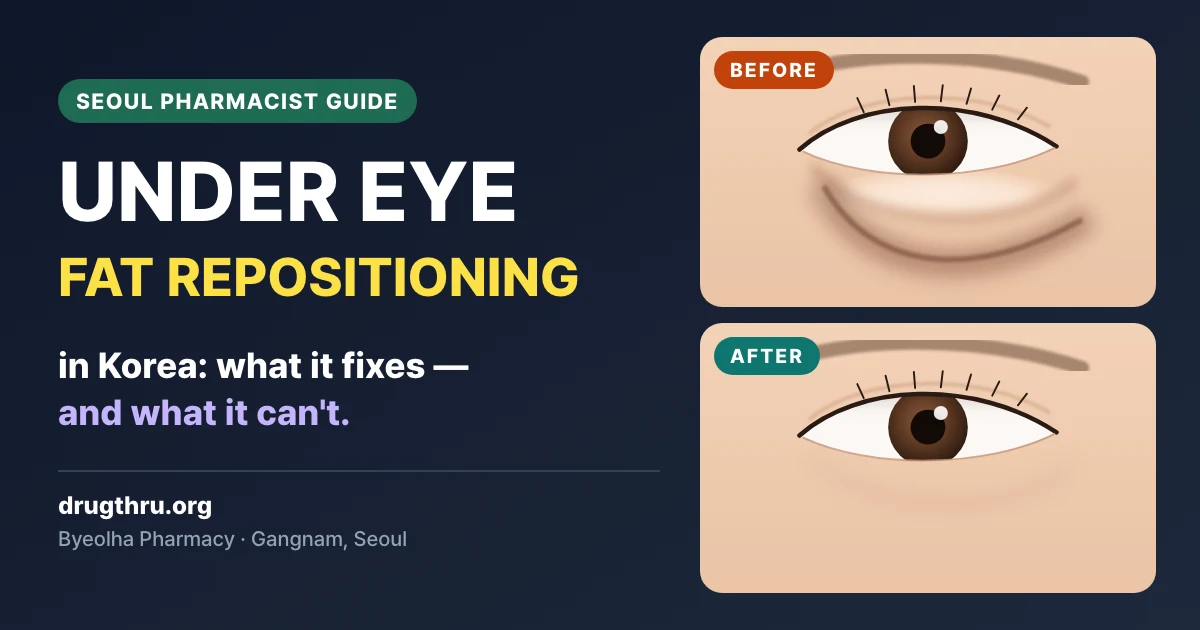
Under eye fat repositioning is one of the procedures visitors fly to Seoul for most often. In Korean clinics it’s called nunmit jibang jaebaechi (눈밑지방재배치) — literally “rearranging the fat under the eyes”. Instead of cutting the eye-bag fat out, the surgeon moves it down into the hollow below.
I’m a pharmacist, not a surgeon, and I don’t work with any clinic. What I see is the other end: people filling their post-op prescriptions in Gangnam. This guide explains what the surgery actually does, who it suits, what a realistic before-and-after looks like, typical Korean prices — and the aftercare medicines you’ll be handed.

1. What is under eye fat repositioning?
Everyone has fat pads around the eyeball. With age — or simply because of your genes — this fat can push forward through the lower lid and form an eye bag. Right below the bag there is often a groove (the tear trough). The bulge above and the dip below together cast the shadow that makes people look tired.
Older lower-lid surgery mostly removed the bulging fat. The problem: taking fat out can leave the area hollow, which looks older over time. Fat repositioning keeps the fat on its own blood supply and slides it down over the bony rim to fill the groove. The bag flattens and the hollow fills, using tissue you already have.

Surgeons have moved toward this approach. A review in the Indian Journal of Ophthalmology (2020) cites a survey in which about 80% of US oculoplastic surgeons said they prefer fat repositioning when doing lower-lid surgery.
2. Who it suits — and who it doesn’t
Eye surgeons say the inside-the-lid approach works best for people who have bulging fat but not much extra skin. In practice that’s often people in their 20s to 40s with inherited eye bags.
- Good fit: a visible bag plus a groove or dark shadow below it, and skin that still snaps back
- Good fit: you’ve had tear-trough filler that keeps looking puffy or needs constant top-ups
- Probably not enough alone: loose, wrinkled lower-lid skin — that needs skin removal (lower blepharoplasty)
- Won’t help: brown or purple dark circles caused by pigment or thin skin with no bulge
- Hollow only, no bag: there’s nothing to move. Filler or fat grafting is the usual option
- Blood thinners, aspirin, or supplements such as fish oil, vitamin E or ginkgo
- Dry eye, recent LASIK, or thyroid eye disease
- Previous filler under the eyes — some surgeons dissolve it first
- Blood pressure or diabetes, and every medicine you take at home
3. How the surgery is done
- Consultation and marking. The surgeon checks the bulge, the groove, the skin and how tight the lower lid is. Bring photos if you’ve had filler before.
- Anaesthesia. Usually local anaesthetic, often with sedation so you’re drowsy. Ask which one and whether someone must take you home.
- The incision. In the common transconjunctival method, the cut is on the pink inner surface of the lower lid, so there’s no scar on the skin.
- Moving the fat. The surgeon releases the tight band along the groove and slides the fat pads down over the rim, fixing them in place with fine stitches.
- Optional extras. If there’s loose skin, a thin strip may be removed just under the lashes (a “skin pinch”), which leaves a fine scar there.
- Going home. The whole thing usually takes about an hour and you leave the same day with ice, eye ointment and a prescription.
4. Before and after: what you can expect
Searching for “under eye fat repositioning before and after” mostly shows clinic photos, taken in perfect light. Here’s what the surgery can and can’t do, so you can judge those photos yourself.

- Smoother lid-to-cheek line: the bag and the groove blend into one gentle curve — the main change people notice
- Less shadow: “dark circles” that are really shadow from the groove usually look lighter
- Long-lasting: in a study of 41 patients followed for at least 44 months, the correction held in all of them (J Cosmet Dermatol, 2021)
- Not a skin treatment: fine lines, sun damage and pigment stay the same
- Not instant: the first 2 weeks look swollen; judge the result at around 3 months
5. Fat repositioning vs lower blepharoplasty, fat grafting and filler
| What it does | Best when | |
|---|---|---|
| Fat repositioning | Moves your own eye-bag fat into the groove | Bag + groove, firm skin |
| Lower blepharoplasty | Removes or moves fat and trims loose skin | Bag + loose, wrinkled skin |
| Fat grafting | Injects fat taken from your thigh or belly | Hollow with no bag |
| Filler | Hyaluronic acid gel into the groove; temporary | Mild hollow, no bag, no surgery |
These are often combined. In Korea “fat repositioning” sometimes comes bundled with a skin pinch or a little fat grafting — ask exactly what’s included in the quote, because it changes both the price and the recovery.
6. Fat repositioning in Korea: cost
Korean clinics set their own prices, and prices for foreigners can differ from local ones. From what clinics and patient guides published in 2026:
- Under eye fat repositioning: mostly ₩1.5–2.5 million; English-language clinic pages quote roughly US$700–3,000
- Lower blepharoplasty (with skin): around ₩2–3.5 million
- Under-eye fat grafting: around ₩1–2 million
- Tear-trough filler: around ₩200,000–600,000 per session
What pushes a quote up: IV sedation, adding a skin pinch or fat grafting, surgeon seniority, and agency or interpreter fees. Get the quote in writing and check whether follow-up visits and medicines are included.
7. Recovery: how long to stay in Korea

- First 48 hours: cold compresses on and off, head raised on pillows, no bending or heavy lifting
- Days 1–3: swelling peaks. Eyes may feel gritty or dry and vision can be blurry from the ointment
- Around day 5–7: follow-up visit; skin stitches, if you had a skin pinch, usually come out now
- Week 1–2: most visible swelling and bruising settle
- Sun: wear dark sunglasses and protect the area until it has fully healed
- Flying: most people fly home after the check-up, about a week in. Ask your clinic when it’s safe for you
- Severe pain that keeps getting worse, especially on one side
- The eye becomes tense, bulging or very swollen, or you can’t open it
- Any loss or dimming of vision, or new double vision
- Fever, pus or spreading redness
Bleeding behind the eye after lower-lid surgery is rare, but it threatens sight and needs treatment within hours. Save your clinic’s emergency number before the operation.
8. Your aftercare medicines: a pharmacist’s notes
In Korea, clinics usually don’t hand out medicines themselves. You get a paper prescription and fill it at any pharmacy — there’s almost always one in the same building or next door. Eye surgeons commonly prescribe an antibiotic (or antibiotic-steroid) eye ointment or drops for the first week, and sometimes tablets for pain or infection.
- Ask for English directions. Korean labels only list doses in Korean. Ask the pharmacist to write the name and timing of each medicine in English
- Drops before ointment. If you have both, use the drops first and wait about 5 minutes before the ointment
- Ointment blurs vision for a while. Use it before sleep when you can, and don’t touch the tube tip to your eye
- Pain: acetaminophen (Tylenol in Korea) is the usual choice. Don’t add aspirin or ibuprofen unless your surgeon says so — they can increase bleeding and bruising
- Dry, gritty eyes: preservative-free artificial tears in single-use vials are sold over the counter and are gentle on a healing eye
- Bruising on the cheek: a bruise gel can go on the cheek skin once the area has healed — never inside the eye or on the lid edge
- Take leftover medicine home with its prescription slip, in case customs or your own doctor asks what it is
9. Under eye fat repositioning FAQ
About the author
Lee Jeong-hoon is a licensed pharmacist (15 years, Korean license no. 61641). He worked in pharmaceutical R&D and regulatory affairs at a multinational drug company before opening Byeolha Pharmacy in Gangnam, which he has run for seven years.
He is not a surgeon and has no ties to any clinic. This guide summarises published medical sources and what he sees when visitors bring post-op prescriptions to the pharmacy.
- EyeWiki (American Academy of Ophthalmology) — Lower Eyelid Blepharoplasty (updated Feb 2026)
- Lower eyelid blepharoplasty: An overview. Indian J Ophthalmol, 2020
- Majidian M, Kolli H, Moy RL. Transconjunctival lower eyelid blepharoplasty with fat transposition above the orbicularis muscle for improvement of the tear trough deformity. J Cosmet Dermatol, 2021
- American Society of Plastic Surgeons — Eyelid surgery: recovery
- Korean clinic and patient-guide price listings for under-eye surgery (checked Oct 2026)
© 2026 DrugThru