Korean Pharmacy Skincare After a Procedure: EGF vs PDRN Explained
Just had a laser, microneedling, or injectable treatment at a Gangnam clinic? What you apply over the next two weeks matters more than most people realize. Here’s what a licensed pharmacist actually recommends when it comes to Korean pharmacy skincare — and what the research behind these ingredients really says.
Reviewed by Jeonghoon Lee, Licensed Pharmacist
Byeolha Pharmacy, Sinnonhyeon Station, Gangnam-gu, Seoul · 15+ years in clinical pharmacy
Gangnam is home to one of the highest concentrations of dermatology and plastic surgery clinics in the world, and many international visitors fly in specifically for treatments here. But clinics usually hand you a small aftercare kit and send you on your way. Once that runs out — often within three or four days — most travelers have no idea what to buy next. That’s usually the moment people start looking into Korean pharmacy skincare.
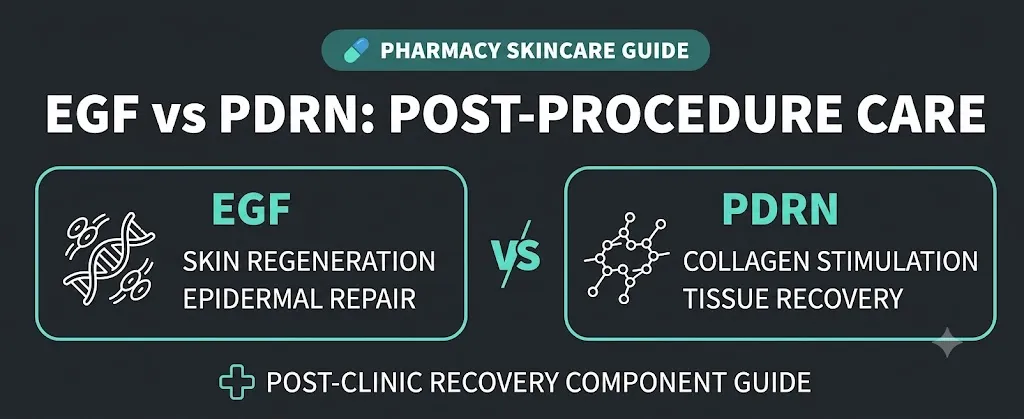
This guide covers the two ingredients pharmacists here most often recommend after a procedure: EGF (epidermal growth factor) and PDRN (polydeoxyribonucleotide). Both sit at the centre of the Korean pharmacy skincare aisle, both have real published research behind them, and both are frequently misunderstood by shoppers.
⚠️ First, an honest clarification
EGF and PDRN topical creams sold in pharmacies are cosmetics, not prescription drugs. The strongest clinical evidence for these ingredients comes from injectable or medical-grade formulations administered by doctors — not from over-the-counter creams. Topical products can still support your skin barrier during recovery, but you should treat them as supportive care, not as a medical treatment. Always follow your clinic’s specific aftercare instructions first.
EGF in Korean Pharmacy Skincare: What It Actually Does
Epidermal growth factor is a naturally occurring protein in your skin that signals cells to divide, migrate, and repair. It plays a central role in wound healing and tissue maintenance by regulating cell survival, proliferation, migration, and differentiation.
The clinical foundation goes back decades. A randomized, double-blind trial published in the New England Journal of Medicine in 1989 studied skin-graft donor sites in twelve patients, applying EGF-containing cream to one site and a control cream to another on the same patient. The EGF-treated sites showed accelerated epidermal regeneration in every single patient. Later research confirmed EGF promotes re-epithelialization and angiogenesis, and phase 3 trials in Korea found topical recombinant human EGF significantly reduced healing time in diabetic foot ulcers.
Pharmacist’s note: The evidence above comes from medical-grade EGF ointments used on genuine wounds. Cosmetic EGF serums use far lower concentrations, and EGF is a large, unstable molecule that struggles to penetrate intact skin. After a procedure, however, your skin barrier is temporarily compromised — which is exactly when topical delivery is most plausible. That’s the window where these products make the most sense.

What Is PDRN, and How Does It Differ from EGF?
PDRN is a highly purified DNA polymer derived from salmon sperm. It works through a completely different mechanism than EGF: it activates adenosine A2A receptors and supplies nucleotides through the salvage pathway, which together promote angiogenesis, reduce inflammation, and support collagen synthesis.
PDRN has genuine regulatory history behind it. It was approved by the Italian Medicines Agency back in 1994 for treating superficial wounds, skin ulcers, and connective tissue disorders. Reviews of the clinical literature report improved healing in chronic ulcers and faster epithelial regeneration at surgical donor sites, alongside an excellent safety profile with minimal adverse events across trials.
If you’ve heard of Rejuran — the injectable “salmon DNA” treatment popular in Korean clinics — that’s PDRN. Studies confirm its role in enhancing collagen deposition and remodeling for skin revitalization. The topical creams sold in pharmacies use the same ingredient family at cosmetic concentrations, which is why they’re often recommended as a follow-up to in-clinic treatment rather than a replacement for it.

EGF vs PDRN: Which One Do You Actually Need?
🧬 EGF
Best suited for
The first few days after ablative lasers, microneedling, or any procedure that leaves visible micro-injury. Focused on speeding up surface-level repair.
Mechanism
Directly signals keratinocytes to proliferate and migrate.
🧪 PDRN
Best suited for
The weeks following injectables, skin boosters, or collagen-stimulating treatments. Focused on longer-term texture, elasticity, and hydration.
Mechanism
Anti-inflammatory and pro-angiogenic via adenosine A2A receptors.
In practice, many people use both — EGF in the immediate recovery window, PDRN as ongoing maintenance. But this depends entirely on which procedure you had. That’s the part worth asking a pharmacist about in person, because the right answer for a CO2 fractional laser is not the right answer for a filler appointment.
A Realistic Recovery Timeline
Follow your clinic’s instructions exactly. Keep the area clean, avoid actives entirely (no retinol, no vitamin C, no exfoliating acids), and don’t introduce anything your clinic didn’t approve.
This is typically when clinic aftercare kits run out and when EGF-based products are most commonly introduced. Barrier support and gentle hydration are the priority. Sunscreen becomes non-negotiable.
Once the skin has re-epithelialized, PDRN-based products are often introduced for longer-term texture and elasticity support. Actives can gradually return, but slowly and one at a time.
🚩 When to contact your clinic instead of a pharmacy
- Spreading redness, warmth, or swelling that worsens after day 3
- Pus, unusual discharge, or fever
- Pain that increases rather than decreases over time
- Skin that turns white, grey, or unusually dark near an injection site
These are not situations for over-the-counter products. Contact your treating clinic immediately.
Frequently Asked Questions
Can I buy EGF and PDRN products without a prescription in Korea?
Yes. The topical cosmetic versions are available over the counter. Injectable PDRN treatments like Rejuran, however, must be administered by a licensed medical professional at a clinic.
Why choose Korean pharmacy skincare over a beauty store?
Some formulations are only distributed through pharmacy channels in Korea. Beyond availability, a pharmacist can check your product against any medications you’re taking and tell you honestly whether a product suits your specific procedure — or whether you should wait.
Do these creams work as well as the injections?
No, and anyone claiming otherwise is overselling. Injectable formulations deliver the active ingredient directly into the dermis at far higher concentrations. Topical products are supportive care during recovery — a useful complement, not a substitute.
Can I bring these products back home on a flight?
Cosmetic creams and serums are generally fine in checked luggage, and in carry-on if under 100ml. Rules vary by destination country, so check your own customs regulations for quantity limits if you’re buying in bulk.
Not Sure Where to Start?
Take our quick skin assessment before you visit — it takes about a minute and asks about your procedure, skin type, and concerns. Bring your result to the pharmacy and our pharmacist can pick up right where you left off.
Available in English, Korean, Japanese, and Chinese · No sign-up required
Related Guides
Where to Buy Reju-all PDRN in Seoul
A closer look at one of the PDRN formulations available in Korean pharmacies.
THOME CPR Triple-Synergy Serum Guide
On retinal-based products — and why you should wait before reintroducing them.
Dr. Melaxin Neck Cream Guide
Targeted dermocosmetic care for the neck area.
Visit Byeolha Pharmacy in Gangnam
Location, opening hours, and how to find us from Sinnonhyeon Station.
References
- Brown GL, et al. Enhancement of Wound Healing by Topical Treatment with Epidermal Growth Factor. New England Journal of Medicine, 1989. View study →
- Shin SH, et al. The use of epidermal growth factor in dermatological practice. International Wound Journal, 2023. View on PubMed →
- Squadrito F, et al. Polydeoxyribonucleotide: A Promising Biological Platform to Accelerate Impaired Skin Wound Healing. PMC. View review →
- Versatile and Marvelous Potentials of Polydeoxyribonucleotide for Tissue Engineering and Regeneration. PMC. View review →
Shop Korean Pharmacy Skincare With a Pharmacist
Bring your clinic’s aftercare instructions with you. Our English-speaking pharmacists in Gangnam can look at what you were given, ask about your treatment, and tell you honestly what’s worth buying — and what isn’t. No pressure to buy anything.
Visit Byeolha Pharmacy →Sinnonhyeon Station (Line 9 / Shinbundang Line), Exit 3 · English, Japanese, Chinese spoken
This article is general information for educational purposes and is not medical advice. It does not replace guidance from the clinic that performed your procedure. If you experience signs of infection or an adverse reaction, contact your treating physician.