
A Juvelook cream is not
a Juvelook injection.
They share an ingredient, but they don’t share a destination. That difference decides almost everything about what you can expect.
If you’ve looked into skin boosters in Seoul, you’ve probably come across Juvelook — the injectable PDLLA treatment that clinics here are known for. And then you’ve probably noticed the creams.
Same ingredient on the label. A fraction of the price. No needles, no downtime, no appointment.
People ask me about this at the counter almost every week. So here is the honest version, from a pharmacist who has no reason to oversell it.

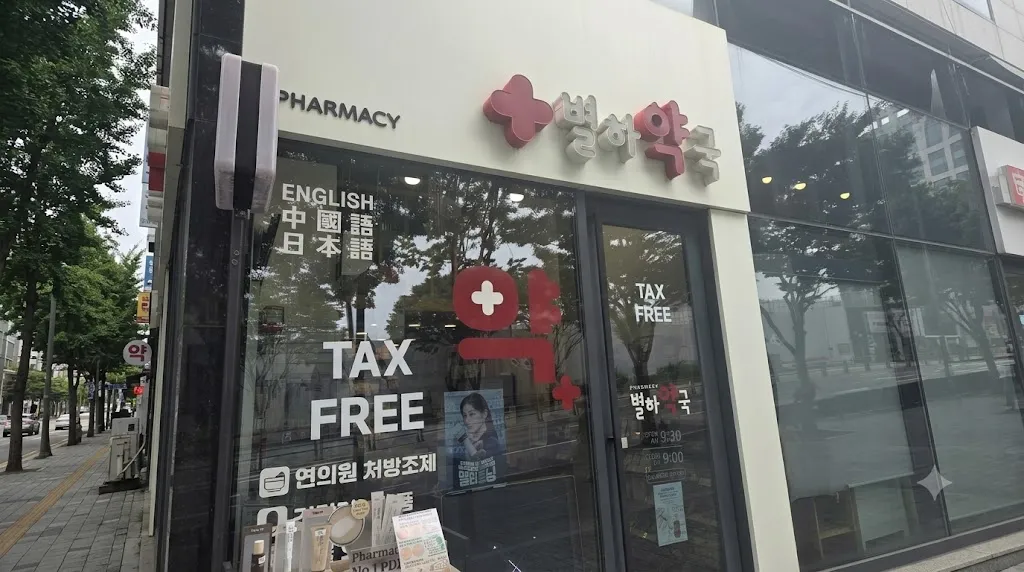
Byeolha Pharmacy (별하약국) — Gangnam, Seoul. One minute from Sinnonhyeon Station Exit 3, surrounded by the district’s clinics.
Sat 9:00–18:00
WeChat · Tax refund
What PDLLA actually is
PDLLA stands for poly-D,L-lactic acid. It’s a biodegradable polymer, and it’s been used in medicine for decades — dissolvable surgical sutures are made from the same family of materials.
In aesthetics, it works as a collagen stimulator. When PDLLA particles are placed in the dermis, the skin responds to them as a mild foreign material and gradually lays down new collagen around them. Over months, that added collagen is what changes how the skin looks.
Notice the wording there: placed in the dermis. That part matters more than anything else in this article.
Why a Juvelook cream can’t do what the injection does
Your skin’s outermost layer, the stratum corneum, exists specifically to keep things out. It is very good at its job.
Dermatology has a rough working principle for this, often called the 500 Dalton rule: molecules heavier than about 500 daltons generally don’t cross intact skin in meaningful amounts.
PDLLA is a polymer. Polymers are, by definition, long chains of repeating units, which puts them far above that threshold. A PDLLA particle sitting on the surface of your face is not going to travel down into the dermis on its own.
bypasses the barrier entirely.
That’s the whole mechanism. Not a better formula, not superior absorption technology. A needle.
You’ll see phrases like “needle-free equivalent”, “activates fibroblasts deep within”, or “rebuilds skin density from the inside.”
Ask one question when you see them: how did the molecule get past the stratum corneum? If the answer isn’t there, the claim is doing something other than describing science.
Research into carrier systems — nanoparticles, exosomes, microneedles — is genuinely active right now, and some of it is promising. But a carrier system is a specific, disclosed technology, not a word on a box.
So is the cream useless?
No. And this is where I’d push back on the opposite extreme too.
A well-formulated cream does real things. It supports your skin barrier, holds hydration, and improves how skin looks and feels day to day. Barrier health is not a consolation prize — it’s genuinely one of the highest-return things you can do for your skin.
What it isn’t is a substitute for a dermal procedure. Those are two different categories of intervention, and expecting one to replace the other is how people end up disappointed after spending money.
Where a cream makes the most sense
- As maintenance after an in-clinic treatment. Your clinic did the structural work; your daily routine keeps the skin in good condition while it remodels.
- When you’re not ready for injectables. Perfectly reasonable. Just calibrate what you expect.
- As part of a consistent routine. Consistency over years beats any single product.
Where it doesn’t
- As a replacement for volume restoration. Significant volume loss is a structural issue, and topicals don’t address structure.
- When you’re layering it onto already-irritated skin. More actives on a compromised barrier makes things worse, not faster.
If you’ve just had a procedure in Gangnam
This is the situation I see most often, since we’re a short walk from a lot of clinics.
Your clinic’s aftercare instructions come first, always. Beyond that, the general principle for the first couple of weeks is less, not more: gentle cleansing, barrier support, sunscreen, and no new actives until your skin has settled.
I’ve written a fuller guide on what’s worth buying after a procedure here:
Frequently asked questions
Q Will a Juvelook cream give me the same result as the injection?
No. The injection places PDLLA directly into the dermis, where the collagen response happens. A topical product stays at the surface. Anyone telling you otherwise is selling, not explaining.
Q Then why do these creams get good reviews?
Because a good moisturiser genuinely improves how skin looks and feels — hydration, texture, and barrier function are visible. That’s real. It just isn’t the same mechanism as collagen stimulation in the dermis.
Q Can I use one right after a clinic procedure?
Follow your clinic’s instructions first. In general, the days right after a procedure call for simple barrier care rather than new active ingredients. Bring your aftercare sheet in and we can go through it with you.
Q Do I need a prescription to buy this in Korea?
No. Topical products of this type are cosmetics and available over the counter. Injectable PDLLA treatments are a different matter entirely and must be administered by a licensed medical professional at a clinic.
Q Can I take these home on a flight?
Creams are generally fine in checked luggage, and in carry-on under 100ml. If you’re buying in quantity, check your destination country’s customs limits before you fly.
Come talk it through
If you’re in Gangnam and unsure what’s actually worth buying, come by. Bring your clinic’s aftercare sheet if you have one.
We’ll tell you honestly what fits your situation — including when the answer is that you don’t need anything new. That happens more often than you’d think.
Byeolha Pharmacy
Sinnonhyeon Station (Line 9 / Shinbundang Line), Exit 3 · English, Japanese and Chinese spoken
Weekdays 9:30 AM – 9:00 PM · Saturday 9:00 AM – 6:00 PM
SHOW THIS AT THE COUNTER OR TO A TAXI DRIVER
서울 강남구 신논현역 별하약국
Byeolha Pharmacy, Sinnonhyeon Station, Gangnam-gu, Seoul
- Molecular weight as a determinant of skin penetration — the 500 Dalton rule
- Penetration Enhancement of Topical Formulations, PMC
- Korea Ministry of Food and Drug Safety, cosmetics labelling and advertising guidance
This article is general information and is not medical advice. It does not replace guidance from the clinic that performed your procedure, and it is not a recommendation to purchase any specific product. If you experience an adverse skin reaction, contact your treating physician.